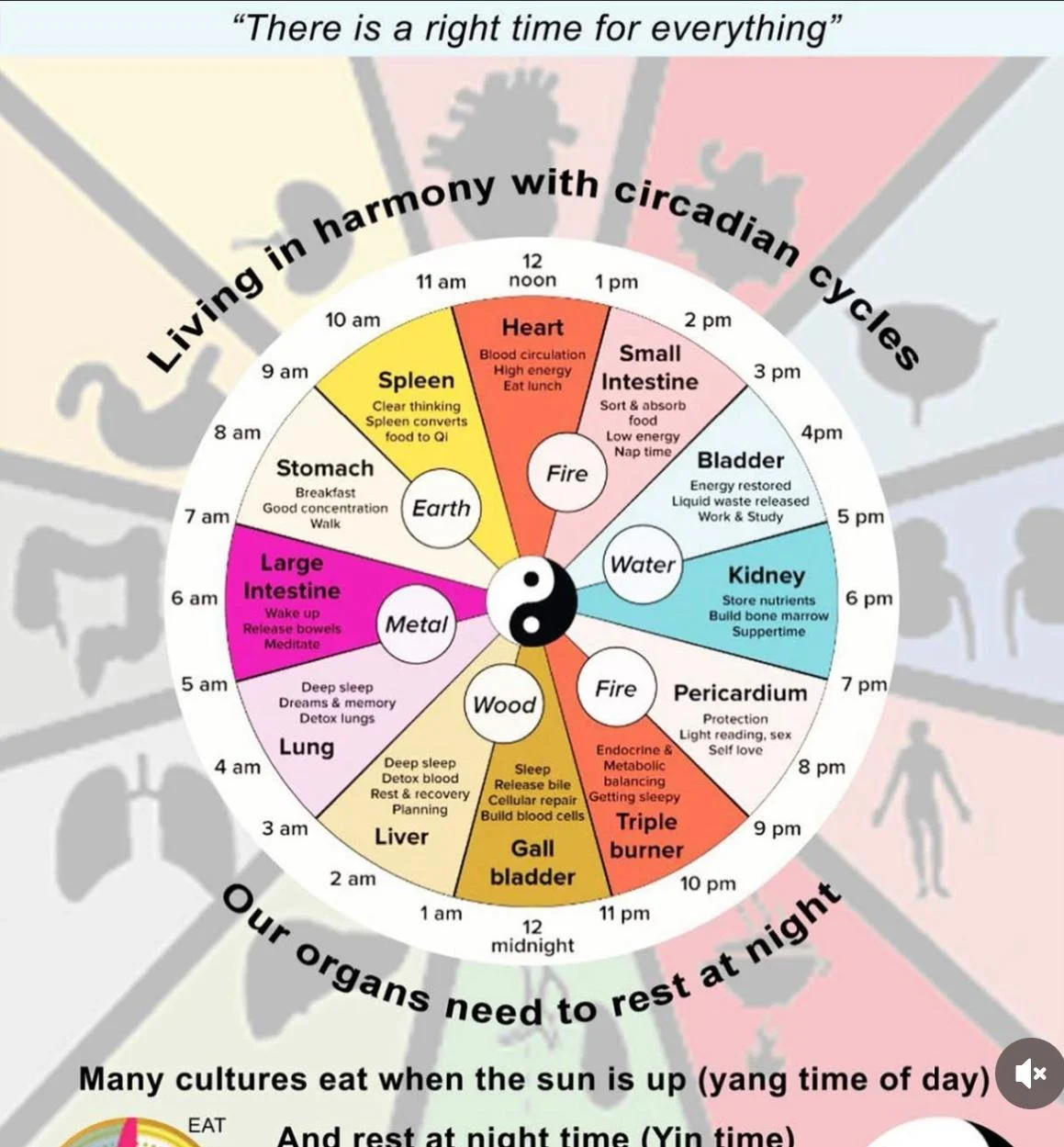
Your organs and the Chinese Medicine Body Clock
I have been asked a few times recently, both online and in clinic about the body clock and it’s significance to Traditional Chinese medicine (TCM) so I wanted to do a blog post with a little bit more information on this topic as I, and I know many others, find it absolutely fascinating! The links I have made in clinic between symptoms suffered by my patients at certain times of the day and the corresponding organ systems and unprocessed or past emotions is mind boggling.
If you haven’t heard of the the Chinese medicine body clock before, it is core concept in Traditional Chinese Medicine (TCM) that describes how the body’s vital energy flows through 12 specific organ systems in a predictable 24-hour cycle. Each organ system has a two-hour period of peak activity and an opposite time of lowest energy, which is used by practitioners as a diagnostic tool to identify physical and emotional imbalances. For example, if a patient comes into clinic and says they are always waking up at 3am and this is happening in a somewhat predictable pattern I will question them on the health of their liver- do they have any history of menstrual issues, anger, irritability, road rage? If they answer yes, then we know there is some imbalance going on in the liver which we can then work on resolving. Often people have mysterious symptoms, but TCM is great at unraveling what is really going on beneath the surface. So, let’s delve a bit more into each organ system and what your body may be trying to tell you if you have symptoms at these times.
How the Clock Works
Each organ has a "peak" time—a two-hour window when its energy is most abundant for performing its physical and emotional duties. Conversely, 12 hours later, that same organ is at its lowest energy point. By aligning your daily activities (like eating, working, and sleeping) with these peak times, you can optimise your health and mental clarity.
The 12 Organs and Their Emotional Connections
In TCM, organs do not just perform physiological tasks; they also process specific emotions. If you consistently feel a certain emotion or wake up at a specific time, it may indicate an imbalance in the corresponding organ.
Lungs (3 AM – 5 AM)
Emotion: Grief
Function: Deep breathing and oxygenating the blood. Waking now can signal unresolved grief. The lungs are linked with the skin in Chinese medicine. Persistent skin issues (eczema, dry skin etc) can be linked to an issue with lung health (but not always) this can also be linked to grief, many people may find their lung issues started after experiencing a significant loss of some kind. Many patients speak of asthma symptoms starting after the loss of a loved one. If you think about times when you have lost someone, it can feel like the air is literally taken out of you- you physically struggle to take a breath, the shock and pain is too strong. Here, we can see how grief relates to the lungs.
Large Intestine (5 AM – 7 AM)
Emotion: Guilt or letting go.
Function: Elimination and letting go. This is the ideal time for a morning bowel movement. Many people have issue at this time if they are stuck in a cycle of holding onto the past. Quite literally their bodies will not excrete waste as they are unable to let go, causing constipation. We all know people who hold onto every issue from the past, no matter how small. They may remember a wrong look or word said to them from 20 years ago and still hold onto this grudge, unable to forget, it consumes them. This is not necessarily a character fault, rather an imbalance in the large intestine that can be treated.
Stomach (7 AM – 9 AM)
Emotion: Disgust or Despair, worry overthinking.
Function: Digestion and nourishment. TCM recommends eating your largest, warmest meal now. The stomach and spleen function is digestion, to send clear fluid to the lungs. If there are stomach issues then this process can be interrupted. Linked to the spleen- overthinking can damage this organ. For this reason it is important to eat when we are calm and not stressed.
Spleen/Pancreas (9 AM – 11 AM)
Emotion: Worry and Overthinking.
Function: Transformation of food into Qi and mental clarity. This is a really interesting one. Many people report being stuck in a cycle of overthinking and how they just cannot switch off on a night due to thought spiralling around their minds. This is usually linked to a disruption of the spleen and weak spleen qi. This can be improved with the correct diet for the spleen and strengthening the qi.
Heart (11 AM – 1 PM)
Emotion: Joy (or Over-excitement/Anxiety).
Function: Governing blood circulation and the "spirit" (Shen). Also the opposite of joy is lack of joy. We often see those people with red rosy cheeks, life of the party, loud and always laughing have underlying heart issues. Too much joy weakens the heart. Opposite to this is a lack of joy. An imbalance in the heart can mean people struggle to find joyful moments in life. Strenuous activity is not good to do at this time. If you are going to the gym, running, weight lifting etc this should be avoided during these hours to lesson the burden on the heart.
Small Intestine (1 PM – 3 PM)
Emotion: Insecurity or Abandonment.
Function: Sorting pure nutrients from waste. It governs our ability to make clear decisions. Physically, it separates pure from impure, mirroring its mental role in sorting thoughts, while its partner, the Heart, houses the mind (Shen). Imbalances can lead to difficulty making decisions, mental fog, or even manic joy, impacting clarity and peace.
Bladder (3 PM – 5 PM)
Emotion: Irritation or Timidness, fear.
Function: Fluid metabolism and detoxification. Linked with the kidney in tcm. Issues with the bladder can be related to underlying fear, phobias.
Kidneys (5 PM – 7 PM)
Emotion: Fear and Insecurity.
Function: Storing "Jing" (essence/vitality) and filtering blood. The kidneys are the bodies life essence. Strong kidney health is imperative to vitality and longevity. Some people are unfortunately passed down weak kidney jing from their parents and so we have to work extra hard to preserve the remaining energy as much as we can. These people should not ever participate in activities that further weaken their kidneys such as cold water swimming, ice baths, sexual over activity or excessive exercise
Pericardium (7 PM – 9 PM)
Emotion: Difficulty Expressing Emotions.
Function: Protecting the heart and managing emotional intimacy. Troubles at this time can signify the protector of the heart is struggling.
Triple Burner/San Jiao (9 PM – 11 PM)
Emotion: Confusion or Paranoia.
Function: Regulating metabolism, temperature, and homeostasis. Thyroid problems? This can be an issue with the san jiao. Symptoms at this time can signify the body being out of balance overall and struggling to get back to homeostasis. It is the furnace" or "thermostat" of the body, regulating metabolism, temperature, and fluid distribution.
Gallbladder (11 PM – 1 AM)
Emotion: Resentment or Indecisiveness.
Function: Storing bile and supporting self-esteem. I also find this one fascinating. Since having her gallbladder removed, my mother has really struggled with decision making! To the point she will ask everyone to make simple decisions for her as she just does not have trust in herself to do so! Have you heard the term ‘they have got the gall to do that’?! This is related to the gallbladders ability to be bold and make a decision. If you have a weakness in this organ this will be impaired.
Liver (1 AM – 3 AM)
Emotion: Anger, Frustration, and Rage.
Function: Cleansing blood and ensuring smooth Qi flow. Waking at this time often points to high stress. PMS, irritable, painful periods, road rage, anger, resentment, tight shoulders, stress?? These all point to liver issues. This is the most commonly seen pattern in todays society. Not surprisingly right?! With our busy, fast paced, high stress lifestyle. If this is held in then the liver qi will stagnate, causing a whole host of symptoms.
Did you find this blog post interesting? I will be creating more so stay tuned! And in the meantime if you have any questions then feel free to send me a message or better still book in for some acupuncture treatment and let’s balance those organs ;)